What Should You Expect to Pay for a Website Design?
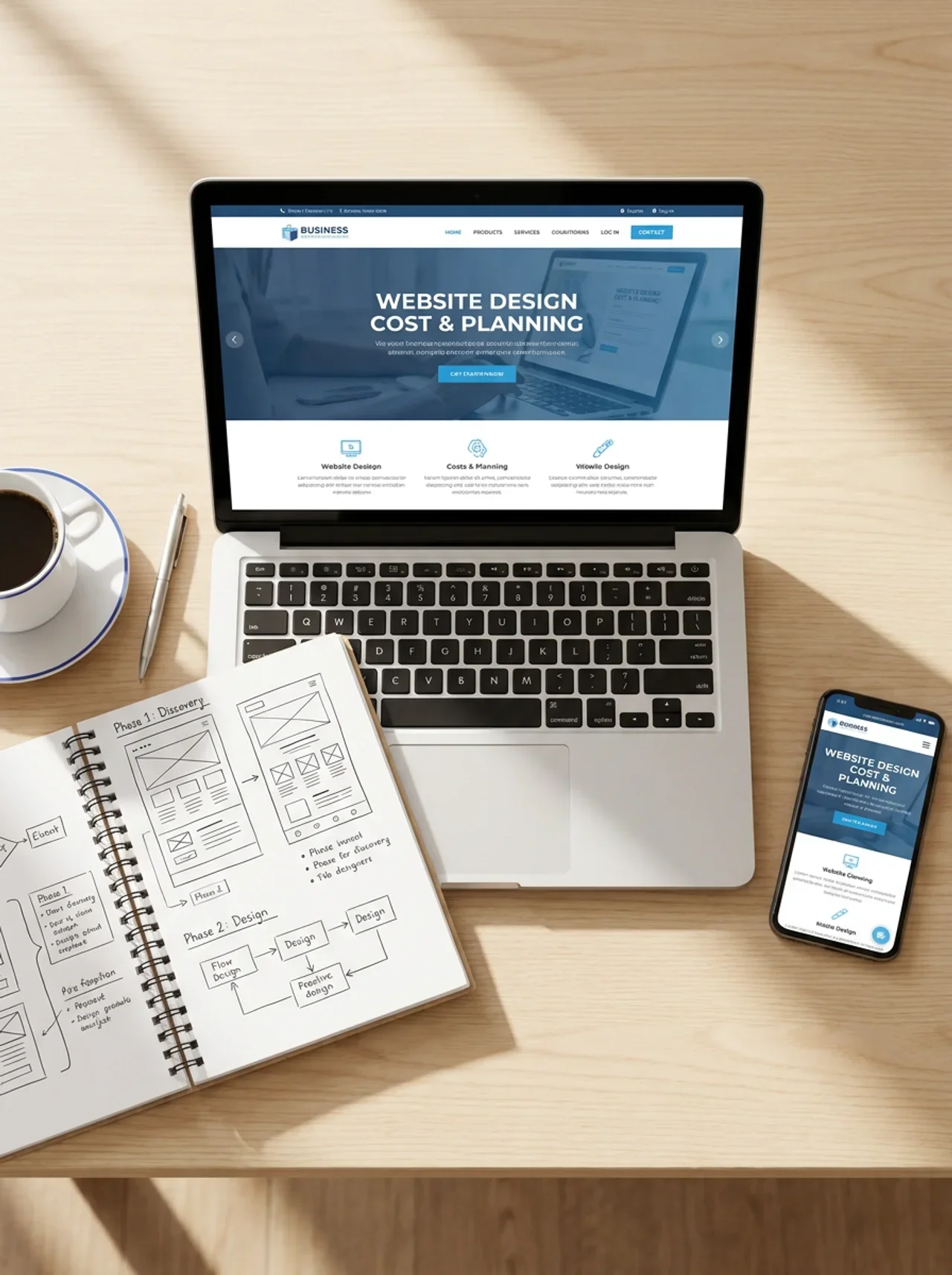
For most small businesses, a professional website costs between $2,500 and $5,000. A simple 2–3 page site starts around $2,500, while a more complete 5–6 page site — the size I recommend for most businesses — runs closer to $5,000. That higher number isn’t just “more pages.” It includes professional copywriting, custom design, image generation when needed, full analytics and tracking setup, and a build that’s structured to actually turn visitors into leads. From there, you can either manage the site yourself or move to a monthly plan to keep it growing. Below, I’ll break down what drives those numbers, what’s actually included, and how to think about whether the investment is right for you.
The Real Price Ranges for a Website
When people ask what a website “should” cost, they’re usually hoping for one clean number. The honest answer is that it depends mostly on how many pages you need — but here’s the framework we use.
A Small Site: Around $2,500
If you only need a couple of pages — say a homepage, an about page, and a contact page — you’re looking at roughly $2,500 for a 2–3 page build. This works for a very simple presence, but it’s rarely my first recommendation if you’re serious about being found online
The Recommended Sweet Spot: Around $5,000
A 5–6 page website is what I recommend for most businesses. That typically includes a homepage, individual service pages, a contact page, an FAQ page, and so on. There are two big reasons I push people toward this size. The first is client experience. When someone lands on your site, a well-organized set of pages guides them through what you do and builds trust along the way. The second is search engine optimization. When you have a dedicated page for each service, it’s far easier to rank each of those pages for the specific things people are searching for. A single crowded page trying to do everything almost always ranks worse than several focused pages each doing one job well.
What Actually Drives the Price Up or Down
The biggest factor in pricing is simply the number of pages that need to be built. More pages means more design work, more copywriting, and more optimization. What I want to be clear about is that price tier does not change how carefully the work is done. Even on a more budget-friendly build, every page is meticulously combed through to make sure the design and the copywriting are the best they can be. A smaller budget means a smaller site — not a sloppier one. That’s a distinction a lot of people don’t realize they should be asking about.
What’s Actually Included in the Price
This is where a lot of quotes start to look very different from one another, and where cheaper options quietly leave things out. Here’s what goes into a typical build around the $5,000 range.
The Build Itself
We build the entire site in Squarespace from start to finish, and hosting is handled by Squarespace, so that’s one less thing for you to manage. We also do all of the copywriting for every page, written and optimized for SEO from the ground up rather than added as an afterthought. For imagery, if you have professional photos, I’d much rather use those — real photos of your business almost always win. If you don’t have them, we can generate professional images using AI image generation software so the site still looks polished and complete.
The Tracking Stack Most People Skip

On an average build, we set up Google Analytics, Google Tag Manager, and Google Search Console. This is one of the clearest places where cheaper options and a lot of freelancers cut corners. Without that tracking in place, you have no real visibility into who’s coming to your site, where they’re coming from, or what they’re doing once they arrive. You’re essentially flying blind.
The Sales Funnel Most Builders Ignore
This is the piece I care about most, and it’s the one most web design companies and freelancers overlook entirely. A pretty website is not the only goal. The goal is a site built as a sales funnel — one that’s structured to actually generate a warm lead after a potential client clicks through. Anyone can make something that looks nice. Far fewer people build something designed to convert a visitor into someone who’s ready to reach out and do business with you.
What Happens After the Site Launches
Once the build is done, you have two options. The first is to simply manage the site yourself from there. That’s a real option and it’s fine for plenty of businesses. The second is our SEO and website maintenance plan, which runs $999 a month. With that plan, we build four blog posts every month aimed at ranking for the questions your potential clients are actually asking. We also handle revisions to the site as needed as part of that monthly package. The idea is that your website doesn’t just sit there after launch — it keeps growing, keeps answering real search questions, and keeps pulling in new leads over time.
Is a Cheap or DIY Website Ever the Right Call?
I’ll be honest about this, because it matters. A cheap site or a do-it-yourself build is perfectly fine if you’re not trying to grow. If you’re happy with where your business is, you’re not looking to generate more leads, and you don’t need a stronger online presence, then there’s no reason to spend more than you have to. But if you’re serious about growing your online presence and generating more high quality leads, that’s a different conversation. This is where the investment earns its keep.
The Biggest Regret I See

The most common regret isn’t that someone spent money on a website. It’s that they waited too long to do it. People consistently wish they had invested in their online presence sooner, because every month without a professional, optimized site carries a real opportunity cost — leads that went to a competitor, searches you never showed up for, and warm prospects you never captured.
Thinking About a Website as an Investment, Not a Cost
The way to frame this is to stop thinking of a website as a one-time expense and start thinking of it as an asset that works for you. A professional site that’s optimized for Google — and increasingly for AI search, which is becoming a major way people find businesses — is out there generating awareness and leads around the clock. When it’s done right, it doesn’t just cost you money once. It earns its cost back by bringing you the kind of high-quality leads that grow the business.
The Bottom Line
Expect roughly $2,500 for a small 2–3 page site and around $5,000 for the more complete 5–6 page build I recommend for most businesses. That number gets you professional copywriting, thoughtful design, the full Google tracking stack, and — most importantly — a site built as a sales funnel that’s designed to turn visitors into warm leads. From there, you can manage it yourself or keep the momentum going with ongoing SEO and maintenance. If you’re serious about growth, the real question isn’t whether you can afford a professional website. It’s how much that next year of leads is worth to you.